
By Rajesh Kumar Singh
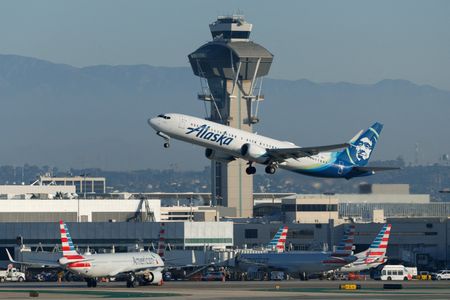
CHICAGO, Sept 29 (Reuters) – Alaska Air Group is making its biggest push yet into premium travel, adding lie-flat seats, premium-economy cabins and new airport lounges to earn more from travelers willing to pay for comfort while high jet fuel prices squeeze its profits.
In an interview ahead of its investor day on Tuesday, President and Chief Financial Officer Shane Tackett told Reuters the investments could eventually add $3 to $4 to Alaska’s earnings per share and lift its margins by 2 to 3 percentage points within a couple of years.
It is a sizable bet as U.S. airlines race to move upmarket. The industry’s domestic premium seat capacity in June was 27% above 2019 levels, nearly three times the growth in economy seats, according to Visual Approach Analytics.
That raises the risk that premium supply eventually outruns demand, pressuring fares.
But Tackett said Alaska’s estimate assumes “a pretty steady rate of demand” for premium seats and the prices it expects to charge.
PREMIUM BET
The push is part of Alaska’s transformation after its 2024 acquisition of Hawaiian Airlines, which added widebody aircraft and a larger Pacific network for international expansion.
Beginning in 2028, Alaska plans 12 lie-flat Aurora Suites on each of at least 25 Boeing 737 MAX 10s used on select transcontinental routes. It will add Premium Reserve, a premium-economy cabin, to Boeing 787s, Hawaiian’s Airbus A330s and some MAX 10s.
Alaska also plans new lounges in Seattle, Honolulu and San Diego.
FUEL CLOUDS OUTLOOK
Tackett did not reaffirm the 2027 timetable for Alaska’s $10-a-share earnings target. Since the plan was set in late 2024, tariff-driven demand weakness and a US government shutdown forced flight cuts in 2025, while the Iran war sent jet fuel prices sharply higher this year.
“Whether that happens in 2027, or a bit later, it will be highly dependent” on fuel prices and the broader economy, Tackett said.
In January, Alaska forecast a profit per share in the range of $3.50 to $6.50, but it pulled the outlook in April after the fuel price surge. In a small Raymond James survey, nearly seven in 10 investors expected Alaska to earn less than $6 a share in 2027.
Tackett said Alaska’s business is configured to perform strongly at prices of about $3.25 a gallon or lower. A broad US benchmark stood at $4.40 a gallon on Monday, Airlines for America data showed.
Alaska is also targeting up to $4 billion in annual cash payments from banks and other partners for its loyalty program by 2030 and plans an Atmos debit card in early 2027.
The broader transformation includes plans to serve 15 long-haul international destinations from Seattle by 2030, up from an earlier goal of 12.
Tackett said Alaska needs to offer international flights and premium products from Seattle to retain and grow customer loyalty.
“This is a must-do for us,” he said.
(Reporting by Rajesh Kumar Singh; Editing by Jamie Freed)
Brought to you by www.srnnews.com
SRN News — View the original story at SRNNews.com.