
By Ezgi Erkoyun, Helen Reid and Simon Jessop
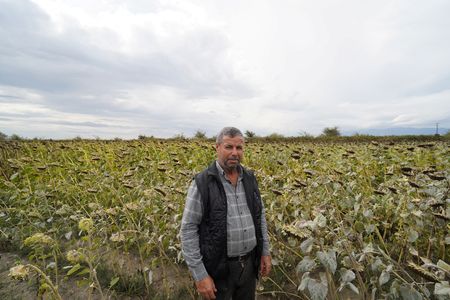
SOKE, Turkey, Nov 9 (Reuters) – Farmer Mehmet Kabak has grown cotton on the same land in drought-prone western Turkey for decades. This year he is planting wheat and sunflower instead, in part because they require less water, making them cheaper to grow.
Kabak is one of many farmers worldwide forced to find their own way to cope with a changing climate rather than wait for countries to settle long-standing arguments at annual climate talks over who should finance adaptation.
Agriculture accounts for around 5% of Turkey’s economic output. It also consumes 79% of the country’s water, almost half of which is lost because of inefficient infrastructure and irrigation, the government has said.
As the next round of climate talks begins on Monday at COP31 in Antalya on the Mediterranean coast, 59-year-old Kabak, who farms 900 decares (about 220 acres) in Soke, hundreds of kilometres to the west, cannot afford to keep making losses.
Government support payments have not kept pace with rising fuel and fertiliser costs linked to irrigation and the US-Israeli war with Iran.
“We had increases in irrigation costs even though our harvest is damaged,” Kabak said. “Our input costs increased by 40%, 50%, 60% continuously. Fuel prices did not stop.”
SHRINKING COTTON ACREAGE
Turkey was the world’s eighth-largest cotton producer, according to 2023 data from the UN’s Food and Agriculture Organization, but its overall seed cotton output is expected to fall 38% year-on-year to 1.2 million metric tons in 2026, according to the Turkish statistics institute.
Drought and increased costs have led farmers in the Soke region to shrink cotton acreage by around 60% to around 120,000 decares in 2026, a local farming group said.
More than 30 farmers, lenders, companies and non-profit organisations told Reuters in interviews the sector needed more technical support and help gaining access to finance.
“Adaptation is no longer optional for farmers, but it is expensive, and today they largely pay for it themselves,” said Aysegul Selisik, Turkey representative of the FAO.
TEMPORARY REPRIEVE FROM WATER SHORTAGE
For agriculture, water is the most pressing adaptation issue.
Last year, Turkey suffered the worst drought in over 50 years. Rainfall was 27% below the long-term average. Dam levels have recovered to an extent, government data showed, but analysts say the reprieve is likely to be temporary.
Reuters analysis of data from the WWF and Lincoln Institute of Land Policy showed water use in Turkey’s cotton-producing basins needs to fall 25% to 60% to sustain healthy ecosystems.
Existing infrastructure is inefficient. Water drawn from dams and rivers often arrives unfiltered, clogging drip hoses before infrastructure to clean it is built.
But farmers are reluctant to invest for a variety of reasons.
In some cases, switching to newer systems can lead to an initial drop in yield that farmers may struggle to absorb. In addition, many work on rented land, meaning they are reluctant to invest, industry representatives said.
STATE AND PRIVATE SECTOR OFFER SOME SUPPORT
Turkey said in October, when it laid out next year’s budget, the amount set aside for land and water resources management would rise 40.5%, with 174 billion lira ($3.5 billion) earmarked for agricultural irrigation investments.
The Agriculture Ministry told Reuters further support would be needed to supplement that, including from the private sector.
Turkey’s largest private lender İşbank has opened 56 specialist agricultural branches and offers financing for drip and sprinkler irrigation with repayments tied to harvest cycles.
Şekerbank, which has a history of supporting farmers, says around a quarter of loans made under its sustainable-finance framework in the first nine months of 2026 went to agricultural water management and climate adaptation.
A lack of equity or collateral and the inability of some farmers to repay the loans, however, have limited the amount of help the private sector can deliver. Many farmers also have to pay upfront and get reimbursed later, if conditions are met.
“That makes it very difficult for them,” said Liam Chicca, country director for Turkey at the International Fund for Agricultural Development.
The fund, which has invested $850 million in Turkey since 1982, estimates between 5% and 10% of Turkish farmers have virtually no capacity to finance major investments themselves.
For Turkey — and other governments — failure to adapt could cost more than acting now.
World Bank analysis in 2022 estimated a 10% reduction in water supply could cost Turkey 6% of GDP, or about $50 billion because of the impact on agriculture.
Apart from the planned budget increase, Turkey’s government has said private companies could help more by adopting water-efficiency certification and using green-finance instruments to fund adaptation, an approach it hopes to advance at COP31.
Those monitoring progress are keen that whatever is proposed amounts to more than the kind of non-binding pledges that governments have made at previous UN conferences without delivering concrete change.
“Success in Antalya should be measured not by pledges, but by how much finance reaches the farm and the watershed,” said FAO’s Selisik.
($1 = 50.1508 liras)
(Reporting by Ezgi Erkoyun in Soke, Turkey; Ebru Tuncay in Istanbul; Simon Jessop and Helen Reid in London; editing by Barbara Lewis)
Brought to you by www.srnnews.com
SRN News — View the original story at SRNNews.com.