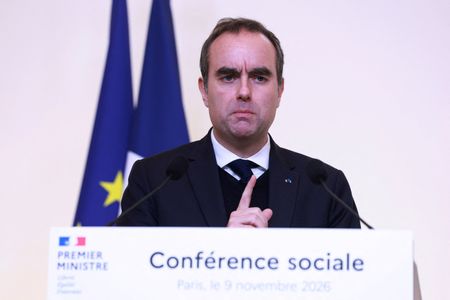
PARIS, Nov 9 (Reuters) – French Prime Minister Sebastien Lecornu said on Monday he was bringing forward a planned hike in the minimum wage to December from January, as he sought to defuse a cost-of-living crisis that has sparked some of France’s worst civil unrest in years.
The government has faced a series of demonstrations in recent weeks which started over underfunded schools but have morphed into broader protests, including riots in major cities on October 17 that caught security forces off guard.
France’s national minimum wage would normally be raised on January 1 to reflect inflation, but instead the government will raise it by 1.6% in December, Labour Minister Jean-Pierre Farandou told a press conference.
The increase will bring the monthly minimum wage to a net €1,502 ($1,676), up €24 from the current level, where it has been since June, when it was raised by €35 to reflect higher inflation.
The government is concerned about mounting social tensions five months before a presidential election in which far-right leader Marine Le Pen is the frontrunner in the polls.
The hike falls short of union demands, with the CFDT, France’s largest union, calling for a €100 increase, while the left-wing CGT union is demanding a 10% rise, equivalent to around €150 a month.
“This is the second-biggest increase in 20 years, so it should not be held in contempt,” Lecornu told journalists after meeting with unions and employers’ federations.
CFDT head Marylise Leon said the increase was “insufficient” after the meeting, while CGT head Sophie Binet described it as “crumbs” and added: “We didn’t come here to beg for alms.” Binet also called for new protests on November 17.
POLITICALLY SENSITIVE
France combines one of Europe’s highest minimum wages with one of the largest shares of workers paid at or near that level.
The minimum wage amounted to 67% of average earnings in 2024, while 12.7% of employees were paid at or near the minimum wage, compared with 8% in Germany and 3.5% in the Netherlands, according to Eurostat data.
Changes to the minimum wage, which in France usually is automatically increased in line with inflation in January and sometimes midyear, therefore have a particularly broad impact on labour costs and are a politically sensitive subject.
The government is eager to find ways to ease public anger but it has little room for manoeuvre because of its mounting debt burden.
Protests erupted in high schools in September but have since spiralled into a broader outpouring of anger over living costs, public services and political stagnation.
The unrest comes five months before France’s presidential election. Opinion polls currently suggest far-right candidate Marine Le Pen will face hard-left rival Jean-Luc Melenchon in a run-off.
French President Emmanuel Macron, who is coming to the end of his second term and whose approval ratings have hit a record low in opinion polls, is barred from running again.
($1 = 0.8961 euros)
(Reporting by Gabriel Stargardter and Leigh Thomas; Additional reporting by Inti Landauro; Editing by Gareth Jones and Hugh Lawson)
Brought to you by www.srnnews.com
SRN News — View the original story at SRNNews.com.