
By Nolan D. McCaskill and Richard Cowan
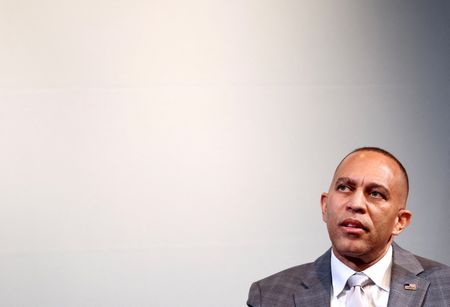
WASHINGTON, Nov 18 (Reuters) – Democrats in the US House of Representatives will choose their nominee for speaker on Wednesday. For some progressive newcomers to Congress, it also marks the first opportunity to formally register their discontent with Democratic leader Hakeem Jeffries.
“We’re not going to rubber-stamp anything,” said Representative-elect Adam Hamawy of New Jersey, who has not committed to backing Jeffries. “We want to sit and have a conversation about the issues and what’s the plan going forward.”
Jeffries, a New Yorker who has led Democrats in the minority since 2023, is poised to easily win the closed-door, secret-ballot vote. A separate roll-call vote to elect the speaker of the House is expected on January 3, when Jeffries or incoming House Republican leader Jim Jordan of Ohio must clinch 218 votes to win the speaker’s gavel to lead the chamber and become second in line to the presidency.
While Jeffries is poised to be elected speaker in January, Wednesday’s vote will show how far he must go to unify a broad, diverse caucus that stretches from newly elected Democrats in President Donald Trump-won districts to insurgent democratic socialists ahead of that historic floor vote.
Under his leadership, House Democrats gained two seats in the 2024 election and have so far netted more than 40 seats in November’s midterm election, with several races still awaiting calls.
The internal vote will “give every single person the opportunity to weigh in one way or the other on who the caucus feels is best positioned — based on track record, experience, vision — to help move us forward in the new Congress,” Jeffries said at a press conference on Tuesday.
PROGRESSIVE DISCONTENT SURFACES
The internal vote comes as progressive members, incoming freshmen and outside organizations have pushed for new Democratic leadership in the House and Senate. Protesters heckled Jeffries at Democrats’ “What’s Next” conference in Denver last week, and an apparent grassroots effort to draft progressive Representative Ayanna Pressley of Massachusetts into challenging him for speaker has gathered more than 150,000 signatures.
Pressley told constituents at a town hall in Boston on Monday that even though she holds the seat once held by former President John F. Kennedy and ex-Speaker Tip O’Neill, she doesn’t need the title of House speaker “to speak for the people.”
“I will always do that and continue to,” she said.
Jeffries has no challenger, and Democrats’ sweeping gains on election night took away the leverage a bloc of progressives could have held in a narrow incoming majority. Still, Jeffries has insisted he’s taking nothing for granted. He told reporters he would meet with leaders of three groups on Tuesday: the liberal Congressional Progressive Caucus, the moderate New Democrats and conservative Blue Dogs.
“We’re continuing to have conversations across the entire spectrum of the House Democratic Caucus family, talking to the new members,” Jeffries said. “They have a lot of wonderful ideas, fresh ideas, new ideas, about how to advance the ball in a bold way for the American people.”
FRESHMEN DEMAND POLICY FOCUS
Representative Chellie Pingree of Maine, a Jeffries supporter who has spoken to newly elected Democrats about the upcoming speaker vote, said many of them don’t know Jeffries and worry whether their voices will be heard on issues such as Israel funding, ending the Iran war and lowering healthcare costs.
“A lot of people who haven’t served in Congress before, it’s harder to see that role as herding cats,” Pingree told Reuters. “Sometimes people think that the speaker can tell us what to do. That rarely happens in Congress.”
Representative-elect William Lawrence, a progressive who flipped a battleground district in Michigan, told Reuters he has been saying since July he would back Jeffries and intends to keep his word.
“I have been hearing concerns from my constituents who want to know that this election will actually bring real changes, and so I do hope to hear a more ambitious agenda,” Lawrence said.
A group of incoming freshmen aligned with the Democratic Socialists of America told reporters last week that Democrats won by running on populist policies. Incoming freshmen Melat Kiros of Colorado and Claire Valdez of New York said their focus is on the agenda, not the individual leading it.
“What we’re demanding is an agenda,” Kiros said. “It’s about what kind of priorities, what kind of floor votes, what kind of plan do we have to actually fight for the bold change the American people sent us here to do.”
Jeffries has embraced some elements of progressives’ agenda, such as a federal minimum wage increase, a congressional stock trading ban, an overturning of the Supreme Court’s Citizens United decision to get big money out of politics and an expansion of Medicare by lowering the eligibility age; adding vision, hearing and dental to coverage; and covering every child.
“Those are bold actions, meaningful actions, important actions that can be taken on our march toward universal health coverage,” he said.
Forty percent of Democratic respondents have a favorable view of Jeffries in a recent Reuters/Ipsos poll, with 29% expressing an unfavorable view and 30% saying they haven’t heard of him or declining to take a position.
(Reporting by Nolan D. McCaskill. Editing by Michael Learmonth and Aurora Ellis)
Brought to you by www.srnnews.com
SRN News — View the original story at SRNNews.com.