
By Andrea Shalal and Rae Wee
BANGKOK, Oct 17 (Reuters) – High debt levels, rising debt-service costs and a sharp drop in official development assistance are forcing developing countries and institutions that help them to rethink development and look for new sources of funding, including from the private sector.
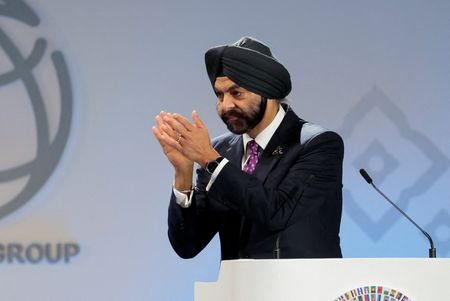
World Bank President Ajay Banga, who has led a drive that has more than tripled the private capital flowing to development projects since 2022, told the annual IMF and World Bank meetings that changes were needed to help countries address headwinds posed by persistent conflicts, a drop in official development assistance and rising debt burdens.
A huge demographic challenge was also unfolding, he said, with some 1.2 billion young people likely to join the job market in the next 10 to 15 years, but only 400 million jobs in sight.
The answer, Banga said, would depend on bringing public finance, private investment, philanthropy and technology together to meet each country’s needs.
British Foreign Secretary Ed Miliband said he would make debt restructuring and other help for the poorest countries a key theme for Britain’s upcoming G20 presidency.
But he said the private sector needed to step up since Britain and other rich nations could not provide the same level of support as during the last big debt forgiveness push at the turn of the millennium.
“The risks of lending to emerging markets have been overestimated and the risk of default has been overestimated,” he told a panel on Wednesday hosted by the Rockefeller Foundation, a private US foundation that works on development.
Developing countries are also looking for answers outside the two Bretton Woods institutions, disappointed by the response to high debt levels, climate change, worsening inequality and geopolitical challenges.
“The world has, in many ways, changed for the worse since 2023,” Shekhar Aiyar, director and chief executive of the Indian Council for Research on International Economic Relations, told an event hosted by the Center for Global Development this week.
“Developing countries have been caught in a downward spiral of decelerating growth and increased vulnerability … at the same time, there has been a vast scaling back of bilateral aid.”
International aid from OECD Development Assistance Committee donor countries fell 23% in real terms in 2025, marking the biggest annual drop in the history of ODA. The top five donors — the US, Germany, UK, Japan and France — all cut aid, together accounting for 96% of the total drop.
Meanwhile, according to UNCTAD — the official UN body responsible for trade, investment and development issues — developing countries’ combined external debt stock reached $12.3 trillion in the same year, up by half a trillion from 2024.
NEW PARTNERSHIPS AND APPROACHES
US President Donald Trump’s sweeping tariffs have added to strains and prompted many developing countries and emerging markets to forge new trade partnerships that do not include the United States.
Indian Finance Minister Nirmala Sitharaman told an Atlantic Council broadcast that countries like hers were plowing ahead with more bilateral partnerships.
“I feel this approach of ‘Yes, we want multilateralism, but yet we’re not waiting for it, we are going ahead with bilateral,’ has really rewarded India,” Sitharaman said.
Eric LeCompte, executive director of Jubilee USA Network, which advocates for debt relief, said this year’s meetings were a big disappointment for developing countries, providing no new initiative to help those already facing steep debt-service payments and now saddled with soaring borrowing costs.
He said the IMF failed to reach critical mass to launch its expanded Poverty Reduction and Growth Trust, which lends to low-income countries at low interest rates, and barely mentioned its Catastrophe Containment and Relief Trust, which provides grants for debt relief to the world’s poorest countries.
“There was a lot of information about how challenging problems are, but we saw hardly any action,” he said, aside from tweaks to debt restructuring plans by the Global Sovereign Debt Roundtable. “We were expecting more,” he said.
Jean Saldanha, director of the European Network on Debt and Development, asked: “Where are the emergency measures to stop countries in the Global South being forced to spend more on debt than on health and education? And where are the serious policy responses to the escalating climate emergency, boosted by a Super El Niño?”
“The least-developed countries have said loud and clear they need more climate grants, less debt, simpler access and faster disbursements,” she said.
Muhammad Al Jasser, who chairs the Islamic Development Bank group, told Reuters there was growing interest in securing private sector funds to augment increasingly scarce public resources.
“The challenges are huge. We’re not going to solve them either single-handedly or even collectively in a short period of time, but I think we are (heading) in the right direction,” he said, adding his bank was aiming to deploy $10 billion in financing next year.
(Reporting by Andrea Shalal and Rae Wee, additional reporting by David Milliken; Editing by John Mair and Hugh Lawson)
Brought to you by www.srnnews.com
SRN News — View the original story at SRNNews.com.
