By Alexander Cornwell and Maayan Lubell
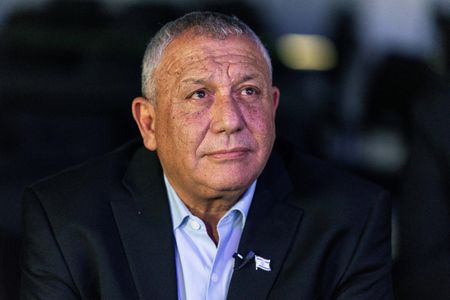
JERUSALEM, Oct 23 (Reuters) – Reserved, media-shy, and a relative newcomer to Israeli politics, former military chief Gadi Eisenkot presents a clear contrast to Prime Minister Benjamin Netanyahu, the veteran leader he aims to defeat in an election next week.
His image as a straight-talking security hawk from humble roots has resonated in a nation going to the polls on October 27 for the first time since Hamas attacked Israel three years ago.
Eisenkot offers a break with Netanyahu’s leadership and far-right allies, but not with the hawkish security views that have hardened since October 7, 2023: He opposes Palestinian statehood and says Hamas’ military wing must be destroyed or dismantled.
Opinion polls show Eisenkot’s Yashar party leading Netanyahu’s Likud, though Israel’s fractured politics mean neither is assured of forming the next government.
Eisenkot has emphasized his security credentials on the campaign trail, citing his “Dahiyeh doctrine” of responding to attacks with disproportionate force, which he deployed as a commander during Israel’s 2006 war with Iran-backed Hezbollah in Lebanon.
His austere public style also sets him apart from Netanyahu, a flamboyant and combative politician who is on trial for corruption and remains widely blamed for the security failures surrounding the October 7 attack, according to opinion polls.
Eisenkot’s public standing is also bound up with the personal price his family has paid since 2023: a son and two nephews were killed fighting in Gaza.
“He’s very likable, not a politician, an everyday person,” said Eitan Shamir, director of the Begin-Sadat Center for Strategic Studies at Bar-Ilan University. “He’s not too sophisticated. People feel they can relate to him.”
Beyond his call to eliminate Hamas’ military capabilities, Eisenkot has said Israel’s next government must prevent Iran from acquiring a military nuclear capability, either by force or through an “arrangement” such as a US-backed diplomatic solution.
He also favours Jewish settlement in the occupied West Bank, where settlements expanded under Netanyahu. Most countries consider the settlements illegal and an obstacle to peace.
But settlement should serve Israeli national interests and must be “legal”, he told Israel’s Channel 7, a comment suggesting opposition to settler outposts established without state approval.
Eisenkot has criticised settler violence against Palestinians, which has surged since 2023, raising tensions in Israel’s ties with Western states, and he opposes Netanyahu’s far-right coalition partners Itamar Ben-Gvir and Bezalel Smotrich, who have both faced sanctions by some Western countries for inciting violence against Palestinians.
MOROCCAN ROOTS
A son of Moroccan immigrants, Eisenkot would be the first prime minister from Israel’s Mizrahi community, Jews who trace their roots to the Middle East and North Africa.
An important constituency for Netanyahu, the Mizrahi community has sometimes been disadvantaged in Israel, particularly in the state’s early decades, which were dominated by Ashkenazi Jews, who trace their roots to Europe.
Eisenkot served in the Israel Defense Forces (IDF) for 41 years, commanding troops in the West Bank during the second intifada, or uprising, and during the 2006 war against Hezbollah in Lebanon.
The “Dahiyeh doctrine” he deployed in 2006 was a deterrent strategy of responding to attacks by militant groups with overwhelming destruction, even of civilian infrastructure, in areas they use. The name refers to Beirut’s Hezbollah-controlled southern suburbs. The UN emergency relief coordinator at the time said the Israeli bombardment of Dahiyeh had breached humanitarian law.
Eisenkot rose to become chief of staff from 2015 to 2019.
The party he founded in 2025 is called Yashar, meaning straight or honest in Hebrew.
JOINED WAR CABINET
After Hamas launched the October 7 attacks, killing 1,200 people and taking another 251 hostage, Eisenkot joined Netanyahu’s war cabinet as an observer.
He quit after eight months, criticising Netanyahu’s leadership.
“I want a simple thing. We defined, and I raised my hand in favor of, the destruction of Hamas’s military and governmental power,” Eisenkot said in the Channel 7 interview.
“We decided to achieve this within a year. Over three years have passed, and it hasn’t happened,” he said, criticizing Netanyahu for declaring a goal of “total victory”.
Israel flattened much of the Gaza Strip after the October 7 attacks, killing 74,000 people, according to Gaza health officials.
A UN inquiry determined Israel committed genocide in Gaza, a finding rejected by Israel.
A peace plan announced by US President Donald Trump a year ago led to a ceasefire and the release of the remaining hostages seized in 2023. Eisenkot said freeing the hostages was the only war goal achieved by Israel.
Trump’s wider Gaza peace plans foresee Hamas disarming, new Palestinian governance for Gaza under international supervision and an Israeli withdrawal. Those goals remain unfulfilled, with Israel occupying more than half of Gaza and Hamas still armed.
Under a Trump-backed plan unveiled in July, Hamas said it had agreed to disarm in return for gradual Israeli withdrawal. But Netanyahu rejected the plan, saying Hamas must be disarmed before any withdrawal.
In the Channel 7 interview, Eisenkot restated the goal of eliminating Hamas’ military power.
“This is where we need to see how it gets done, how Hamas’ military wing is destroyed or dismantled. It must end with that,” he said.
TWO STATES ‘IS A MISTAKE’
He is against statehood for the Palestinians, who have long sought self-determination in the West Bank and the Gaza Strip with a capital in East Jerusalem, telling Channel 7 “two states for two peoples is a mistake”.
“My position is that between the Jordan River and the Sea, Israel must have overriding security responsibility. There must not be any foreign army between the Mediterranean and the Jordan if we wish to live,” he said.
While voicing support for settlements, he has opposed the Netanyahu government’s moves to build homes in what’s known as the E1 bloc, a plan that has drawn particularly strong objections from Western states because it would bisect the West Bank, making a Palestinian state even harder to achieve.
Eisenkot has said he won’t partner with parties representing Arab Israelis because he says none accepts his four core principles, including destroying or dismantling Israel’s enemies. That could complicate Eisenkot’s path to a governing majority even if Yashar emerges as the largest party.
“I will make efforts to bring in more Zionist parties because Israel needs a broad coalition with a government that will bring a broad national consensus,” he told Channel 7.
(Reporting by Alexander Cornwell and Maayan Lubell; Writing by Tom Perry; Editing by Howard Goller)
Brought to you by www.srnnews.com
SRN News — View the original story at SRNNews.com.