WASHINGTON, Nov 2 (Reuters) – President Donald Trump’s Justice Department has shown a willingness to intervene directly in Tuesday’s midterm elections, breaking with decades of practice meant to avoid the appearance that its law enforcement powers are being used to benefit a political party or candidate.
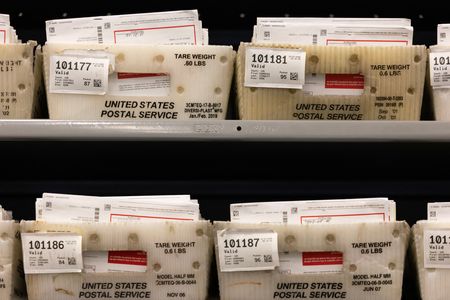
In California, the Justice Department sought to set aside mail-in ballots from about 20,000 voters it alleges are likely non-US citizens ineligible to vote.
The department has also demanded records in a related criminal probe. California has said it has implemented measures to prevent voting by noncitizens and argued the Justice Department does not have the authority to block votes.
In Alaska, the department has intensified a criminal investigation into whether a Senate candidate with the same name as Republican incumbent Dan Sullivan entered the race to confuse voters. It also sought to block certification if Sullivan narrowly loses, but a federal judge dismissed that lawsuit on Sunday.
Courts have now rejected the department’s lawsuits against both states, but the cases underscore the DOJ’s willingness to intervene in election disputes before votes are counted and results certified. The department has appealed the Alaska decision.
Critics say the department could accelerate any attempt by Trump to sow doubt about the midterms, which will determine control of Congress and the winners of dozens of governors’ races.
“It appears that the administration wants the department to have an impact that was previously prohibited,” said Mark Blumberg, who previously led the DOJ’s election response to civil rights threats and has since founded the Rule of Law Project.
US Attorney General Todd Blanche says the department’s efforts are lawful and aim to protect the integrity of the vote.
“The Department isn’t helping any campaign. It’s enforcing the law,” department spokesperson Kiersten Pels said in a statement.
FALSE FRAUD CLAIMS
The US Constitution assigns responsibility for administering elections to the states, but Trump, a Republican, argues Democratic-led states are not doing enough to prevent voting by noncitizens, which is prohibited under US law. He continues to falsely assert that widespread fraud caused his 2020 election loss. Independent studies and state audits have found voter fraud to be rare.
Outside groups aligned with Trump filed more than 60 lawsuits challenging his 2020 defeat, all of which were unsuccessful. DOJ officials in his first term rejected pressure to enlist the department in those efforts.
“The right-wing fringe outside groups are not going to have to do that this year because the DOJ is clearly standing ready and willing to do it,” said Lis Frost, a voting rights lawyer with Elias Law Group, which frequently represents Democrats in court.
Historically, Justice Department election interventions have focused on enforcing federal laws meant to ensure racial minorities or vulnerable populations can vote without impediment.
THE ALASKA CASE
Alaska has become a particularly intense legal battleground after the New York Times reported that Democrat Mary Peltola’s campaign was involved in recruiting retired teacher Daniel J. Sullivan to challenge incumbent Dan Sullivan.
The Justice Department lawsuit, which Trump said he directed the department to file, asked a court to halt certification and order an investigation if the margin suggested voter confusion could have affected the outcome. US District Judge Sharon Gleason in Anchorage dismissed the case on Sunday, finding Alaska could not conduct such a probe while preserving the secrecy of ballots.
Legal experts had said DOJ lacked authority to bring the case and risked appearing to favor the Republican incumbent.
“For the department to be trusted in its law enforcement decisions it has to ensure that people understand it does not take sides in political partisan disputes,” said Peter Keisler, acting attorney general under Republican President George W. Bush. “And this has not only the appearance but the evident reality of taking sides.”
Blanche has said the case sought to stop what he described as fraud by Daniel J. Sullivan, who denies trying to mislead voters. Peltola’s campaign said it had “no involvement with either Sullivan campaign.”
Asked about criticism of the lawsuit, a Justice Department official said at a press briefing on Thursday, “We bring lawsuits to enforce federal law.”
TRUMP ALLIES EMPOWERED
The Justice Department has traditionally proceeded cautiously in election investigations because its involvement can cause uncertainty or be exploited by candidates or political parties.
Its Public Integrity Section, staffed with career experts on election law, has often advised agents and prosecutors to wait until results are certified before intervening, according to former DOJ officials.
The Trump administration has slashed the size of the unit and suspended a requirement that federal prosecutors consult it on election-corruption probes. DOJ officials say US Attorney’s Offices are better positioned to decide whether charges are merited.
Instead, agents and prosecutors have been told that unresolved issues will be decided by Trump political appointees, according to three people familiar with the conversations.
The Deputy Attorney General’s Office will mediate disputes between agents and prosecutors, they said, a direct role that former DOJ officials said it has rarely played in election investigations.
Pels said “resolving disputes that can’t be resolved in the field is exactly the role that office exists to play.”
(Reporting by Andrew Goudsward and Luc Cohen; Editing by Michael Learmonth and Howard Goller)
Brought to you by www.srnnews.com
SRN News — View the original story at SRNNews.com.